| Löwenstein Formation | |
|---|---|
| Stratigraphic range: Mid Norian (Alaunian) | |
| Type | Geological formation |
| Unit of | Keuper |
| Underlies | Trossingen Formation |
| Overlies | Mainhardt Formation |
| Thickness | At least 80 m |
| Lithology | |
| Primary | Sandstone |
| Other | Marl |
| Location | |
| Region | Europe |
| Country |  Germany Germany.svg.png.webp) Switzerland Switzerland |
| Extent | Bavaria, Baden-Württemberg |
The Löwenstein Formation (Stubensandstein in Baden-Württemberg, Burgsandstein in Bavaria) is a lithostratigraphic formation of the Keuper in Germany. It is underlain by the Mainhardt Formation and overlain by the Trossingen Formation. It dates back to the middle Norian.[1]
Fauna
Theropod tracks and an unnamed herrerasaur genus are known from the Lower Stubensandstein.[2]
| Archosaurs of the Stubensandstein | ||||||
|---|---|---|---|---|---|---|
| Genus | Species | Location | Stratigraphic position | Material | Notes | Images |
| Aetosaurus | A. feratus
A. crassicauda |
Lower | 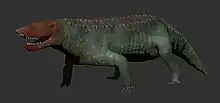 | |||
| Apatosuchus | A. orbitoangulatus | Lower | "Partial skull" | |||
| Dolichosuchus[3] Dubious | D. cristatus[3] | Middle[3] | "Tibia"[4] | Actually indeterminate coelophysoid remains[3] | ||
| Efraasia | E. minor | Lower | 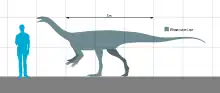 | |||
| Halticosaurus[3] Dubious | H. longotarsus[3] | Middle[3] | "Mandibular fragment, vertebrae, humerus, illium, femur, metatarsal."[4] | Later found to be indeterminate coelophysoid remains[3] | ||
| Liliensternus | L. liliensterni | 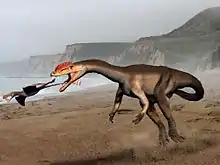 | ||||
| Mystriosuchus | M. ? | 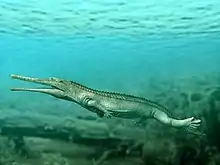 | ||||
| Nicrosaurus | N. kapffiN. meyeri | Middle | 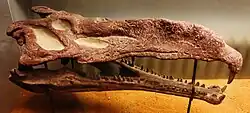 | |||
| Paratypothorax | P. andressi | Middle | 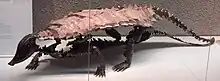 | |||
| Plateosaurus[5] | P. gracilis[5] | "[Twenty one] partial skeletons, isolated elements, [three] partial skulls, juvenile to adult."[6] | Yates assigned the type material of Sellosaurus gracilis to Plateosaurus gracilis [7] | 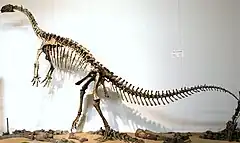 | ||
| Procompsognathus[3] | P. triassicus[3] | Middle[3] | "Partial postcranial skeleton."[8] | 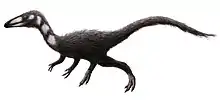 | ||
| Saltoposuchus | S. connectens S. longipes | 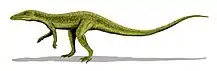 | ||||
| TanystrosuchusDubious | T. posthomus | Middle | " Neck vertebra" | |||
| Teratosaurus[3] | T. suevicus[3] | Middle[3] | Galton and Benton showed that Teratosaurus is actually a rauisuchian.[9][10] | 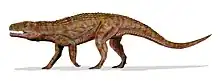 | ||
Other Amniotes
See also
References
- ↑ Weishampel, David B; et al. (2004). "Dinosaur distribution (Late Triassic, Europe)." In: Weishampel, David B.; Dodson, Peter; and Osmólska, Halszka (eds.): The Dinosauria, 2nd, Berkeley: University of California Press. Pp. 521–525. ISBN 0-520-24209-2.
- 1 2 "17.2 Baden-Württemberg, Germany; 1. Lower Stubensandstein," in Weishampel, et al. (2004). Page 524.
- 1 2 3 4 5 6 7 8 9 10 11 12 13 14 15 "17.2 Baden-Württemberg, Germany; 2. Middle Stubensandstein," in Weishampel, et al. (2004). Page 524.
- 1 2 "Table 3.1," in Weishampel, et al. (2004). Page 50.
- 1 2 "17.2 Baden-Württemberg, Germany; '1. Lower Stubensandstein' and '2. Middle Stubensandstein,'" in Weishampel, et al. (2004). Page 524.
- ↑ "Table 12.1," in Weishampel, et al. (2004). Page 236.
- ↑ Yates, A.M. (2003). "Species taxonomy of the sauropodomorph dinosaurs from the Löwenstein Formation (Norian, Late Triassic) of Germany". Palaeontology 46 (2): 317–337
- ↑ "Table 3.1," in Weishampel, et al. (2004). Page 48.
- ↑ Galton, P. M. (1985). "The poposaurid thecodontian Teratosaurus suevicus von Meyer, plus referred specimens mostly based on prosauropod dinosaurs". Stuttgarter Beiträge zur Naturkunde, B, 116: 1-29.
- ↑ Benton, M.J. (1986). "The late Triassic reptile Teratosaurus - a rauisuchian, not a dinosaur". Palaeontology 29: 293-301.
Bibliography
- Weishampel, David B.; Peter Dodson, and Halszka Osmólska (eds.). 2004. The Dinosauria, 2nd edition, 1–880. Berkeley: University of California Press. Accessed 2019-02-21. ISBN 0-520-24209-2
This article is issued from Wikipedia. The text is licensed under Creative Commons - Attribution - Sharealike. Additional terms may apply for the media files.