Y. V. Rao | |
|---|---|
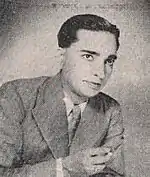 Y. V. Rao in 1948 | |
| Born | Yaragudipati Varada Rao 30 May 1903 |
| Died | 13 February 1979 (aged 75) Chennai, Tamil Nadu, India |
| Nationality | Indian |
| Occupations |
|
| Years active | 1930–1968 |
| Spouse | Kumari Rukmani |
| Children | Lakshmi |
| Relatives |
|
Yaragudipati Varada Rao (Telugu: యెర్రగుడిపాటి వరదరావు; 30 May 1903 – 13 February 1979[1]) was an Indian director, producer, actor, screenwriter, and editor known for his works primarily in Telugu, Kannada, and Tamil films.[2] Rao plunged into theatre and did a few stage plays before moving to Kolhapur and Bombay to act in silent films.[3][4] Rao started his career as a lead actor in many silent films such as Gajendra Moksham (1923),[5] Garuda Garvabhangam (1929),[6] and Rose of Rajasthan (1931).[5][1][7] Regarded as one of the greatest filmmaking pioneers of the Cinema of South India,[3][1] he made motion-pictures across Telugu, Kannada, Tamil, Konkani, and Hindi languages, apart from silent films.[3][1]
Rao made significant contributions to South cinema during the British rule in India. Rao's 1934 film Sati Sulochana was the first talkie film in the Kannada language.[3][1] In 1937, he directed the hagiographical classic Chintamani, the Tamil sleeper hit ran for a year with highest estimated footfall at a single screen in India, and British Ceylon.[8] Rao's 1938 film Swarnalatha was one of the finest political drama scripted by Ayyalu Somayajulu; with prohibition as the central theme, in which Rao played the lead. The film was shot extensively at Newtone Studios, Kilpauk, during Madras Presidency.[1] Rao's 1940 film, Viswa Mohini, is the first Indian film, depicting the Indian movie world, scripted by Balijepalli Lakshmikanta Kavi, starring V. Nagayya.[9] Rao subsequently made the mythology sequel films Savithiri (1941), and Sathyabhama (1942) casting thespian Sthanam Narasimha Rao.[10][4]
Personal life
Yaragudipati Varada Rao was born in Telugu Brahmin family[3][11] of Nellore in the then Madras Presidency of British India in May 1903. In the late 1920s, he moved to Madras and ventured into Kannada cinema.[3] He married Kumari Rukmini who was paired with him in Lavangi (1946). Indian actress Lakshmi is their daughter.[12]
Early career
Rao moved into film direction and made silent films such as Pandava Nirvan (1930), Pandava Agnathavaas (1930) and Hari Maya (1932). In 1932, a Marwari businessman, Chamanlal Doongaji from Bangalore, launched South India Movie Tone. The company made Sati Sulochana, the first talking picture in Kannada with an expense of ₹40,000 (equivalent to ₹14 million or US$170,000 in 2023). Rao directed this blockbuster film shot at Chatrapathi Cinetone, in Kolhapur; the shooting took eight weeks. He then directed Hari Maya (1932) that starred his first wife, Rajam.[3]
Selected filmography
- As Director
- 1930: Pandava Agyathavas (silent)
- 1930: Sarangadhara (silent)
- 1932: Hari Maya (Kannada - Director)
- 1934: Sati Sulochana (Kannada - Cast)
- 1935: Naganand (Hindi)
- 1936: Bhama Parinayam (Tamil)
- 1937: Chintamani (Tamil)
- 1938: Bhakta Meera (Tamil)
- 1938: Swarnalatha (Tamil)
- 1939: Malli Pelli (Telugu - Cast)
- 1940: Viswa Mohini (Telugu - Cast)
- 1941: Savithiri (Tamil - Cast, Singer)
- 1942: Sathyabhama (Telugu - Cast)
- 1944: Thasildar (Telugu - Cast)
- 1946: Lavangi (Tamil)
- 1948: Ramadas (Tamil)
- 1950: Jeevit Amche Ashe (Konkani)
- 1952: Manavathi (Telugu-Tamil)
- 1953: Manjari (Telugu - Cast)
- 1956: Bhagya Chakra (Kannada)
- 1958: Sri Krishna Garudi (Telugu)
- 1961: Nagarjuna (Telugu-Kannada)
- 1963: Hennina Balu Kanneru (Kannada)
- 1973: Stree (Telugu)
- As Producer - Telugu
- 1964: Thotalo Pilla Kotalo Rani
- 1965: Aakasa Ramanna
- 1966: Bhulokamlo Yamalokam
- 1966: Loguttu Perumaallu Keruka
- 1967: Devuni Gelichina Manavudu
- 1967: Gopaludu Bhupaludu
- 1968: Circar Express
- 1968: Pala Manasulu
- 1969: Ardharathri (Cast)
- 1969: Love in Andhra
- 1969: Takkari Donga Chakkani Chukka
- 1970: Paga Sadhistha
- 1971: Revolver Rani
- 1972: Monagadosthunnadu Jagratha[4]
References
- 1 2 3 4 5 6 Guy, Randor (26 July 2014). "Swarnalatha (1938)". The Hindu.
- ↑ Narasimham, M. L. (28 May 2011). "Malli Pelli (1939)". The Hindu.
- 1 2 3 4 5 6 7 Guy, Randor (22 August 2003). "A revolutionary filmmaker". The Hindu. Archived from the original on 19 November 2016. Retrieved 19 November 2016.
- 1 2 3 "Y. V. Rao Fimography". Indiancine.ma.
- 1 2 Baskaran, S Theodore (2004). Em Thamizhar Seidha Padam (Paperback ed.). Chennai: Uyirmmai Padippagam. pp. 46–50. ISBN 81-88641-29-4.
- ↑ Guy, Randor (29 January 2011). "Garuda Garvabhangham 1936". The Hindu. ISSN 0971-751X. Retrieved 10 October 2022.
- ↑ "Viswamohini review Indian express". hindi-films-songs.com.
- ↑ "An unforgettable superhit". The Hindu. 3 March 2008.
- ↑ Narasimham, M. L. (23 June 2013). "Viswamohini (1940)". The Hindu.
- ↑ "A revolutionary filmmaker". The Hindu. Chennai, India. 22 August 2003. Archived from the original on 17 January 2004.
- ↑ "Y V Rao".
- ↑ Randor Guy (25 May 2013). "Blast from the past - lavangi 1946". The Hindu. Archived from the original on 10 September 2013. Retrieved 19 November 2016.