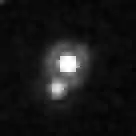
 Hubble Space Telescope image of Typhon and its moon Echidna, taken in 2006 | |
| Discovery | |
|---|---|
| Discovered by | NEAT |
| Discovery date | 5 February 2002 |
| Designations | |
| (42355) Typhon | |
| Pronunciation | /ˈtaɪfɒn/[1] |
Named after | Τυφών Typhōn |
| 2002 CR46 | |
| SDO[2][3] Centaur[4] 7:10 resonance | |
| Adjectives | Typhonian /taɪˈfoʊniən/[5] |
| Orbital characteristics[2] | |
| Epoch 13 January 2016 (JD 2457400.5) | |
| Uncertainty parameter 2 | |
| Observation arc | 9563 days (26.18 yr) |
| Aphelion | 58.982252 AU (8.8236193 Tm) |
| Perihelion | 17.545721 AU (2.6248025 Tm) |
| 38.263987 AU (5.7242110 Tm) | |
| Eccentricity | 0.5414560 |
| 236.70 yr (86453.7 d) | |
| 14.61898075° | |
| 0° 0m 14.991s / day | |
| Inclination | 2.4252078° |
| 351.9098598° | |
| 159.3215723° | |
| Known satellites | 1 (Echidna) |
| TJupiter | 4.692 |
| Physical characteristics | |
Mean diameter | 138±9 km[6] 162±7 km[7] |
| Mass | ≈9.082×10¹⁷ kg[6] |
Mean density | 0.66+0.09 −0.08 g/cm3[6] |
| 9.67 h (0.403 d)[6] | |
| 0.044±0.003[7] 0.10±0.02 | |
| B−V=0.74±0.02 V−R=0.52±0.01 | |
| 7.5 | |
42355 Typhon (/ˈtaɪfɒn/; prov. designation: 2002 CR46), is a scattered disc object that was discovered on February 5, 2002, by the NEAT program. It measures 162±7 km in diameter, and is named after Typhon, a monster in Greek mythology.
Typhon is the first known binary centaur,[8] using an extended definition of a centaur as an object on a non-resonant (unstable) orbit with the perihelion inside the orbit of Neptune.[9]
Moon
| Discovery | |
|---|---|
| Discovery date | 2006 |
| Designations | |
| (42355) Typhon I Echidna | |
| Pronunciation | /ɪˈkɪdnə/[10] |
Named after | Έχιδνα |
| Adjectives | Echidnian[11] Echidnean (rarely)[12] (both /ɪˈkɪdniən/)[13] |
| Orbital characteristics | |
| ~1300 km | |
| 11 d | |
| Satellite of | Typhon |
| Physical characteristics | |
| Dimensions | 89±6 km |
A large moon was identified in 2006. It is named Echidna (formal designation (42355) Typhon I Echidna), after the monstrous mate of Typhon. It orbits Typhon at ~1300 km, completing one orbit in about 11 days. Its diameter is estimated to be 89±6 km.
References
- ↑ "Typhon". Oxford English Dictionary (Online ed.). Oxford University Press. (Subscription or participating institution membership required.)
- 1 2 "JPL Small-Body Database Browser: (42355 Typhon)" (2008-03-14 last obs). Retrieved 12 April 2016.
- ↑ "List Of Centaurs and Scattered-Disk Objects". Minor Planet Center. Retrieved 2008-09-21.
- ↑ (42355) Typhon and Echidna
- ↑ "Typhonian". Oxford English Dictionary (Online ed.). Oxford University Press. (Subscription or participating institution membership required.)
- 1 2 3 4 Duffard, R.; Pinilla-Alonso, N.; Santos-Sanz, P.; Vilenius, E.; Ortiz, J. L.; Mueller, T.; et al. (April 2014). ""TNOs are Cool": A survey of the trans-Neptunian region. XI. A Herschel-PACS view of 16 Centaurs". Astronomy and Astrophysics. 564: 17. arXiv:1309.0946. Bibcode:2014A&A...564A..92D. doi:10.1051/0004-6361/201322377. S2CID 119177446.
- 1 2 Santos-Sanz, P., Lellouch, E., Fornasier, S., Kiss, C., Pal, A., Müller, T. G., Vilenius, E., Stansberry, J., Mommert, M., Delsanti, A., Mueller, M., Peixinho, N., Henry, F., Ortiz, J. L., Thirouin, A., Protopapa, S., Duffard, R., Szalai, N., Lim, T., Ejeta, C., Hartogh, P., Harris, A. W., & Rengel, M. (2012). “TNOs are Cool”: A Survey of the Transneptunian Region IV - Size/albedo characterization of 15 scattered disk and detached objects observed with Herschel Space Observatory-PACS
- ↑ K. Noll; H. Levison; W. Grundy; D. Stephens (October 2006). "Discovery of a binary Centaur". Icarus. 184 (2): 611. arXiv:astro-ph/0605606. Bibcode:2006Icar..184..611N. doi:10.1016/j.icarus.2006.05.010. S2CID 18927838.
- ↑ J. L. Elliot; S. D. Kern; K. B. Clancy; A. A. S. Gulbis; R. L. Millis; M. W. Buie; et al. (February 2005). "The Deep Ecliptic Survey: A Search for Kuiper Belt Objects and Centaurs. II. Dynamical Classification, the Kuiper Belt Plane, and the Core Population" (PDF). The Astronomical Journal. 129 (2): 1117. Bibcode:2005AJ....129.1117E. doi:10.1086/427395.
- ↑ "Echidna". Oxford English Dictionary (Online ed.). Oxford University Press. (Subscription or participating institution membership required.)
- ↑ François Hartog (Janet Lloyd, trans., 1988) The Mirror of Herodotus, p. 25
- ↑ J. A. Weinstock (2014) The Ashgate Encyclopedia of Literary and Cinematic Monsters, p. 79
- ↑ George Sandys (1669) Ovid's Metamorphosis Englished, 6th ed., p. 134.
External links
This article is issued from Wikipedia. The text is licensed under Creative Commons - Attribution - Sharealike. Additional terms may apply for the media files.