| Brill Building | |
|---|---|
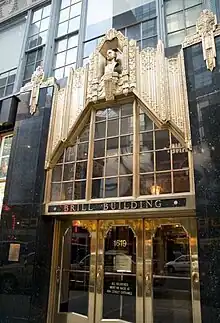 The Brill Building in 2006 | |
| Stylistic origins | |
| Cultural origins | Late 1950s – early 1960s, New York City |
| Typical instruments | |
| Derivative forms | |
| Other topics | |
Brill Building (also known as Brill Building pop or the Brill Building sound)[1] is a subgenre of pop music[1] that took its name from the Brill Building in New York City, where numerous teams of professional songwriters penned material for girl groups and teen idols during the early 1960s.[2] The term has also become a metonym for the period in which those songwriting teams flourished.[7] In actuality, most hits of the mid-1950s and early 1960s were written elsewhere.[7]
Overview
The music conceived at the Brill Building was more sophisticated than other pop styles of the time, combining contemporary sounds with classic Tin Pan Alley songwriting.[1] Productions often featured orchestras and bands with large rhythm and guitar sections,[2] while lyrics focused on idealized romance and adolescent anxieties, only rarely exploring more mature themes.[8]
The genre dominated the American charts in the period between Elvis Presley's Army enlistment in 1958 and the onset of the British Invasion in 1964.[9] It declined thereafter, but demonstrated a continued influence on British and American pop and rock music in subsequent years.[2][3] The genre introduced the concept of professional songwriters to traditional pop and early rock and roll,[3] and helped to inspire the girl group craze of the era.[10] Other reasons for the style's decline was a tendency among writers and producers to duplicate earlier successes, resulting in many records that sounded the same, as well the changing nature of society and consumer markets.[11] Many of the genre's composers went on to further success as part of the singer-songwriter movement later in the 1960s and 1970s.[12]
List of artists
1960s artists/songwriters
Later artists
References
- 1 2 3 4 5 6 7 Fontenot, Robert (November 1, 2015). "What is Brill Building Music?". About. Archived from the original on July 7, 2016. Retrieved October 6, 2016.
- 1 2 3 4 5 6 7 8 9 Anon. "Brill Building Pop". AllMusic.
- 1 2 3 4 5 6 7 8 9 10 11 12 13 14 Gulla 2007, p. 366.
- 1 2 Bessman, Jim (August 25, 2001). "TV's Hitmakers Spotlights Home of Brilliant Songwriting". Billboard. p. 44. ISSN 0006-2510.
- 1 2 Viglione, Joe. "Breaking Up Is Hard to Do". AllMusic.
- ↑ Anon. "Sunshine Pop". AllMusic.
- 1 2 Seabrook 2015, p. 51.
- 1 2 3 4 5 6 7 Hall 2014, p. 39.
- 1 2 "Don Kirshner". The Daily Telegraph. April 18, 2011.
- ↑ New York Times 2011, p. 163.
- ↑ Hall 2014, p. 38.
- ↑ Chris Smith (2009). 101 Albums that Changed Popular Music. Oxford University Press. p. 83. ISBN 9780195373714.
- ↑ Auslander 2006, p. 54.
Bibliography
- Auslander, Philip (2006). Performing Glam Rock: Gender and Theatricality in Popular Music. University of Michigan Press. ISBN 0-472-06868-7.
- Gulla, Bob, ed. (2007). Icons of R&B and Soul: An Encyclopedia of the Artists Who Revolutionized Rhythm. Greenwood. ISBN 978-0-313-34044-4.
- Hall, Mitchell K. (2014). The Emergence of Rock and Roll: Music and the Rise of American Youth Culture. Routledge. ISBN 978-1-135-05358-1.
- New York Times, The (2011). The New York Times Guide to Essential Knowledge: A Desk Reference for the Curious Mind. St. Martin's Press. ISBN 978-0-312-64302-7.
- Seabrook, John (2015). The Song Machine: Inside the Hit Factory. W. W. Norton. ISBN 978-0-393-24193-8.