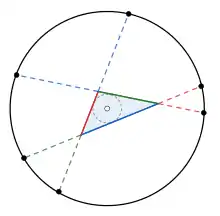
In plane geometry, the Conway circle theorem states that when the sides meeting at each vertex of a triangle are extended by the length of the opposite side, the six endpoints of the three resulting line segments lie on a circle whose centre is the incentre of the triangle. The circle on which these six points lie is called the Conway circle of the triangle.[1][2][3] The theorem and circle are named after mathematician John Horton Conway.
The radius of the Conway circle is

where and are the inradius and semiperimeter of the triangle.[3]


Conway's circle is a special case of a more general circle for a triangle that can be obtained as follows: Given any △ABC with an arbitrary point P on line AB. Construct BQ = BP, CR = CQ, AS = AR, BT = BS, CU = CT. Then AU = AP, and PQRSTU is cyclic.[4]
See also
References
- ↑ "John Horton Conway". www.cardcolm.org. Archived from the original on 20 May 2020. Retrieved 29 May 2020.
- ↑ Weisstein, Eric W. "Conway Circle". MathWorld. Retrieved 29 May 2020.
- 1 2 Francisco Javier García Capitán (2013). "A Generalization of the Conway Circle" (PDF). Forum Geometricorum. 13: 191–195.
- ↑ Michael de Villiers (2023). "Conway's Circle Theorem as a Special Case of a More General Side Divider Theorem". Learning and Teaching Mathematics (34): 37–42.
External links
- Kimberling, Clark. "Encyclopedia of Triangle Centers".
- Conway’s Circle Theorem as special case of Side Divider Theorem at Dynamic Geometry Sketches, interactive geometry sketches.