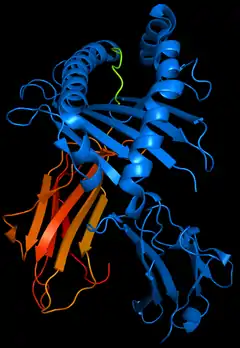
 | ||
| B*5101-β2M with bound peptide 1e28 | ||
major histocompatibility complex (human), class I, B51 | ||
| Alleles | B*5101, 5102, 5103, . . . | |
| Structure (See HLA-B) | Available 3D structures | |
| EBI-HLA | B*5101 | 1e28, 1e27 |
HLA-B51 (B51) is an HLA-B serotype. The serotype identifies the more common HLA-B*51 gene products.[1]
B51 is a split antigen of the broad antigen B5, and is a sister serotype of B52.[2] There are many alleles within the B*51 allele group. B51 is associated with several diseases, including Behçet's disease.
Serotype
| B*51 | B51 | B5 | B52 | B53 | Sample |
| allele | % | % | % | % | size (N) |
| *5101 | 96 | 2 | 1 | 1899 | |
| *5102 | 73 | 3 | 6 | 11 | 218 |
| *5104 | 83 | 17 | 6 | ||
| *5105 | 48 | 16 | 24 | 25 | |
| *5106 | 64 | 7 | 12 | 42 | |
| *5107 | 78 | 9 | 68 | ||
| *5108 | 77 | 3 | 154 | ||
| *5109 | 86 | 43 | |||
| B**5102 also reacts to B5102 - 3%, **5103 with B5103 | |||||
| Alleles link-out to IMGT/HLA Databease at EBI | |||||
Alleles
There are 71 alleles, 57 amino acid sequence variants in B51 of which 4 are nulls. Of these only 9 are frequent enough to have been reliably serotyped. B*5101 is the most common, but others have a large regional abundance.
| freq | ||
| ref. | Population | (%) |
| [4] | Bulgaria | 20.9 |
| [4] | Georgia Tbilisi Georgians | 15.7 |
| [4] | India Tamil Nadu Nadar | 15.6 |
| [4] | China North Han | 14.8 |
| [4] | Georgia Tbilisi Kurds | 12.1 |
| [4] | India Andhra Pradesh Golla | 12.0 |
| [4] | China Qinghai Hui | 11.4 |
| [4] | India New Delhi | 9.8 |
| [4] | Madeira | 9.7 |
| [4] | South Africa Natal Tamil | 9.2 |
| [4] | USA Hawaii Okinawa | 8.7 |
| [4] | Cape Verde Northwestern Islands | 8.1 |
| [4] | Cape Verde Southeastern Islands | 7.3 |
| [4] | India Mumbai Marathas | 6.8 |
| [4] | Russia Tuva pop 2 | 6.1 |
| [4] | Israel Arab Druse | 6.0 |
| [4] | China Inner Mongolia | 5.9 |
| [4] | Czech Republic | 5.7 |
| [4] | Finland | 5.6 |
| [4] | Iran Baloch | 8.1 |
| [4] | Brazil | 5.1 |
| [4] | Mexico Guadalajara Mestizos | 4.9 |
| [4] | New Mexico Canoncito Navajo | 4.9 |
| [4] | China South Han | 4.6 |
| [4] | India North Hindus | 3.8 |
| [4] | Thailand | 3.1 |
| [4] | Ivory Coast Akan Adiopodoume | 2.3 |
| [4] | Singapore Chinese Han | 2.3 |
| [4] | Singapore Javanese Indonesians | 2.0 |
| [4] | Taiwan Saisiat | 2.0 |
| [4] | Kenya | 1.7 |
| [4] | Cameroon Yaounde | 1.6 |
| [4] | Senegal Niokholo Mandenka | 1.6 |
| [4] | Guinea Bissau | 1.5 |
| [4] | USA Arizona Pima | 1.1 |
| [4] | Venezuela Perja Mountain Bari | 1.1 |
| [4] | Taiwan Pazeh | 0.9 |
| [4] | China Guangdong Meizhou Han | 0.5 |
| [4] | Israel Ashk. & Non Ashk. Jews | 0.5 |
| [4] | Singapore Thai | 3.0 |
| [4] | Iran Baloch | 1.0 |
| [4] | USA Asian | 1.0 |
Disease associations
By serotype
Bw51 was associated with Behçet's disease,[5] in endemic (versus epidemic) mucocutaneous lymph node syndrome,[6] susceptibility to the virus that causes German measles infection.[7]
| freq | ||
| ref. | Population | (%) |
| [4] | Mexico Sonora Seri | 1.5 |
| [4] | Thailand | 1.4 |
| [4] | Singapore Chinese | 1.3 |
| [4] | Hong Kong Chinese | 1.0 |
| [4] | USA Natives | 0.8 |
| [4] | Mexico Zaptotec Oaxaca | 0.7 |
| [4] | South Korea pop 3 | 0.6 |
| [4] | Shijiazhuang Tianjian Han | 0.5 |
| [4] | China Guangxi Maonan | 0.5 |
| [4] | Japan (5) | 0.4 |
| [4] | USA Asian | 0.4 |
| [4] | USA Hispanic | 0.4 |
| [4] | USA African America | 0.2 |
In Behçet's disease
Behçet's disease is an inflammation of the wall of blood vessels that can involve the eyes, skin, and the rest of the body.[8] Several alleles of B51 (B*5101, B*5108, B*5105, and B*5104) are found in disease, and linkage to markers, D6S285, in the HLA locus was strong (P<0.005).[9] Homozygotes of B51 showed considerably high risk for disease indicating a possible gene-dose effect. B51 is capable of distinguishing several varieties of disease. HLA-B51 is found more frequently in disease that has an eye involvement.[10] However it is less common in some regions when there is increased neurological involvement.[11] The MICA*009 allele has been found to also associated with ABD when B51 is also present,[12] IL-8 and other cytokines may also be involved.[13][14] Sister chromatid exchange has also been observed more frequently in B51(+) ABD.[15]
However, B51 tends not to be found in ABD when a certain SUMO4 gene variant is involved,[16] and symptoms appear to be milder when HLA-B27 is present.[17]
References
- ↑ Marsh, S. G.; Albert, E. D.; Bodmer, W. F.; Bontrop, R. E.; Dupont, B.; Erlich, H. A.; Fernández-Viña, M.; Geraghty, D. E.; Holdsworth, R.; Hurley, C. K.; Lau, M.; Lee, K. W.; Mach, B.; Maiers, M.; Mayr, W. R.; Müller, C. R.; Parham, P.; Petersdorf, E. W.; Sasazuki, T.; Strominger, J. L.; Svejgaard, A.; Terasaki, P. I.; Tiercy, J. M.; Trowsdale, J. (2010). "Nomenclature for factors of the HLA system, 2010". Tissue Antigens. 75 (4): 291–455. doi:10.1111/j.1399-0039.2010.01466.x. PMC 2848993. PMID 20356336.
- ↑ Cox ST, McWhinnie AJ, Robinson J, et al. (January 2003). "Cloning and sequencing full-length HLA-B and -C genes" (PDF). Tissue Antigens. 61 (1): 20–48. doi:10.1034/j.1399-0039.2003.610103.x. PMID 12622774. Archived from the original (PDF) on 2008-10-28. Retrieved 2008-08-03.
- ↑ derived from IMGT/HLA
- 1 2 3 4 5 6 7 8 9 10 11 12 13 14 15 16 17 18 19 20 21 22 23 24 25 26 27 28 29 30 31 32 33 34 35 36 37 38 39 40 41 42 43 44 45 46 47 48 49 50 51 52 53 54 55 Middleton D, Menchaca L, Rood H, Komerofsky R (2003). "New allele frequency database: http://www.allelefrequencies.net". Tissue Antigens. 61 (5): 403–7. doi:10.1034/j.1399-0039.2003.00062.x. PMID 12753660.
- ↑ Ohno S, Ohguchi M, Hirose S, Matsuda H, Wakisaka A, Aizawa M (September 1982). "Close association of HLA-Bw51 with Behçet's disease". Arch. Ophthalmol. 100 (9): 1455–8. doi:10.1001/archopht.1982.01030040433013. PMID 6956266.
- ↑ Keren G, Danon YL, Orgad S, Kalt R, Gazit E (August 1982). "HLA Bw51 is increased in mucocutaneous lymph node syndrome in Israeli patients". Tissue Antigens. 20 (2): 144–6. doi:10.1111/j.1399-0039.1982.tb00337.x. PMID 6958087.
- ↑ Ishii K, Nakazono N, Sawada H, et al. (1981). "Host factors and susceptibility to rubella virus infection: the association of HLA antigens". J. Med. Virol. 7 (4): 287–97. doi:10.1002/jmv.1890070405. PMID 6950026.
- ↑ Durrani K, Papaliodis GN (2008). "The genetics of Adamantiades-Behcet's disease". Semin Ophthalmol. 23 (1): 73–9. doi:10.1080/08820530701745264. PMID 18214795.
- ↑ Karasneh J, Gül A, Ollier WE, Silman AJ, Worthington J (June 2005). "Whole-genome screening for susceptibility genes in multicase families with Behçet's disease". Arthritis Rheum. 52 (6): 1836–42. doi:10.1002/art.21060. PMID 15934084.
- ↑ Krause L, Köhler AK, Altenburg A, Papoutsis N, Zouboulis CC, Pleyer U, Stroux A, Foerster MH (June 2008). "Ocular involvement is associated with HLA-B51 in Adamantiades-Behçet's disease". Eye. 23 (5): 1182–6. doi:10.1038/eye.2008.177. PMID 18551141.
- ↑ Houman MH, Neffati H, Braham A, et al. (2007). "Behçet's disease in Tunisia. Demographic, clinical and genetic aspects in 260 patients". Clin. Exp. Rheumatol. 25 (4 Suppl 45): S58–64. PMID 17949553.
- ↑ Mizuki N, Meguro A, Tohnai I, Gül A, Ohno S, Mizuki N (2007). "Association of Major Histocompatibility Complex Class I Chain-Related Gene A and HLA-B Alleles with Behçet's Disease in Turkey". Jpn. J. Ophthalmol. 51 (6): 431–6. doi:10.1007/s10384-007-0473-y. PMID 18158593.
- ↑ Lee EB, Kim JY, Zhao J, Park MH, Song YW (February 2007). "Haplotype association of IL-8 gene with Behcet's disease". Tissue Antigens. 69 (2): 128–32. doi:10.1111/j.1399-0039.2006.00736.x. PMID 17257314.
- ↑ Pay S, Simşek I, Erdem H, Dinç A (March 2007). "Immunopathogenesis of Behçet's disease with special emphasize on the possible role of antigen presenting cells". Rheumatol. Int. 27 (5): 417–24. doi:10.1007/s00296-006-0281-6. PMID 17171346.
- ↑ Ikbal M, Atasoy M, Pirim I, Aliagaoglu C, Karatay S, Erdem T (February 2006). "The alteration of sister chromatid exchange frequencies in Behçet's disease with and without HLA-B51". J Eur Acad Dermatol Venereol. 20 (2): 149–52. doi:10.1111/j.1468-3083.2006.01386.x. PMID 16441621.
- ↑ Hou S, Yang P, Du L, et al. (July 2008). "SUMO4 gene polymorphisms in Chinese Han patients with Behcet's disease". Clin. Immunol. 129 (1): 170–5. doi:10.1016/j.clim.2008.06.006. PMID 18657476.
- ↑ Ahn JK, Park YG (October 2007). "Human leukocyte antigen B27 and B51 double-positive Behçet uveitis". Arch. Ophthalmol. 125 (10): 1375–80. doi:10.1001/archopht.125.10.1375. PMID 17923546.