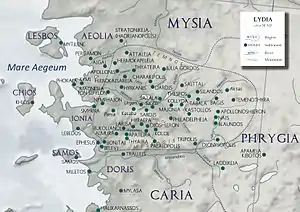
Lydia in about 50 CE.
Hermocapelia or Hermokapeleia, also possibly known as Thyessos, was a town of ancient Lydia.[1] It was inhabited from Classical through Byzantine times.[1] It stood on the Hermus River,[2] "to the west of Apollonis in its own little plain almost completely surrounded by mountains."[3]
It was mentioned by Pliny the Elder[4] and Hierocles[5] but is best known for its coins which it minted,[6][7] and which are in existence today.
The city was the site of an ancient bishopric[8] which remains a vacant titular see to this day.[9][10]
Its site is located in Sakarkaya, Akhisar, south of Suleymanköy in Asiatic Turkey.[1][11]
References
- 1 2 3 Richard Talbert, ed. (2000). Barrington Atlas of the Greek and Roman World. Princeton University Press. p. 56, and directory notes accompanying.
- ↑ John-Anthony Cramer, A Geographical And Historical Description of Asia Minor with a Map. (Oxford University Press, 1832), p 433-434.
- ↑ Halsey L. Royden, The Magistrates of the Roman Professional Collegia in Italy: From the First to the Third Century A.D. (Review by: Willem Jongman) American Journal of Philology Vol. 111, No. 2 (Summer, 1990), pp. 281-283 .
- ↑ Pliny. Naturalis Historia. Vol. 5.30.
- ↑ Hierocles. Synecdemus. Vol. p. 670.
- ↑ Ancient Coinage of Lydia, Hermocapelia.
- ↑ mantis.
- ↑ Michel Le Quien, Oriens christianus (ex Typographia Regia, 1740) p.889.
- ↑ Hermocapelia at catholic-hierarchy.org.
- ↑ Hermocapelia at GCathollic.org.
- ↑ Lund University. Digital Atlas of the Roman Empire.
38°55′18″N 27°36′54″E / 38.921548°N 27.614993°E / 38.921548; 27.614993
| Authority control databases: Geographic |
|---|
This article is issued from Wikipedia. The text is licensed under Creative Commons - Attribution - Sharealike. Additional terms may apply for the media files.