 | |
| Abbreviation | INHIGEO |
|---|---|
| Formation | 1967 |
| Type | INGO |
Region served | Worldwide |
Membership | Members, Associate Members |
Official language | English |
Main organ | Board of Management |
Parent organization | IUGS, IUHPS |
| Website | http://www.inhigeo.com |
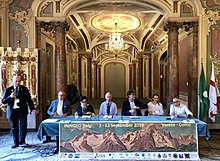
The International Commission on the History of Geological Sciences (INHIGEO) promotes ongoing research into the history of the earth sciences, particularly the history of geology. It has 20 Honorary Senior Members and 301 members (2018)[1] worldwide.
History
INHIGEO has been established by the International Union of Geological Sciences (IUGS) and is also affiliated with the International Union of History and Philosophy of Science (IUHPS). The suggestion for the establishment of INHIGEO in 1967 was chiefly due to the ideas and efforts of the distinguished Russian geologist Vladimir Tikhomirov (1915–1994) from the Geological Institute of the USSR Academy of Sciences.
Board of Management
President:
- 1967 —
 Soviet Union — Vladimir Tikhomirov[2]
 - 1976 —
 Netherlands — Reijer Hooykaas
 - 1984 —
 UK — Gordon Y. Craig[3]
 - 1989 —
 GDR — Martin Guntau
 - 1992 —
.svg.png.webp) Australia — David Branagan
Australia — David Branagan - 1996 — UK — Hugh Torrens
- 2000 —
 Portugal — Manuel Serrano Pinto
 - 2004 —
 France — Philippe Taquet[4]
 - 2008 —
 Brasil — Silvia Fernanda de Mendonça Figueirôa[5]
 - 2012 —
 USA — Kenneth Taylor
 - 2016 — Australia — Barry Cooper
- 2020 —
 Italy — Ezio Vaccari.
Secretary-General:

Objective
The primary objective of the Commission on the History of Geological Sciences involves promoting studies in the history of geological disciplines. In so doing, the Commission endeavours to stimulate and coordinate the activities of regional, national, and international organizations having shared purposes. The Commission also works to foster the publication of individual and collective works that illuminate the history of the geological sciences.
INHIGEO achieves its objective by sponsoring a major annual symposium with associated field activities. It also promotes publication of individual and collective works on the history of geology and issues a substantial "Annual Record" that details historical research into earth sciences worldwide, publicises other pertinent historical activities and provides scholarly reviews of recent literature on the subject.
Strategies
- Meet with regularity, usually once a year, including years of the International Geological Congress, to conduct a major symposium on the history of geology. This typically
includes a multi-day field component, with the production by the Commission of printed guidebooks.
- Produce an annual Newsletter that incorporates information from the officers, national reports, book reviews, conference reports, and a variety of news items and illustrations that
promote sharing of professional insights.
- Make an effort to record the history of the International Geological Congress meetings and relevant IUGS activities.
- Work with various publishing houses and journals, including Episodes,[9] to promote publication of symposia proceedings and a variety of contributions to the discipline.
Meetings
INHIGEO Symposiums:
- 1967 — Soviet Union — Yerevan
- 1968 —
 Czechoslovakia — Prague (with 23rd IGC)
 - 1970 — GDR — Freiberg
- 1972 —
.svg.png.webp) Canada — Montreal (with 24th IGC)
Canada — Montreal (with 24th IGC) - 1974 —
 Spain — Madrid
 - 1975 — UK — London
- 1976 — Australia — Sydney (with 25th IGC)
- 1978 —
 FRG — Münster, Bonn
 - 1980 — France — Paris (with 26th IGC)
- 1982 —
 Hungary — Budapest
 - 1984 — Soviet Union — Moscow (with 27th IGC)
- 1985 — UK — Edinburgh
- 1987 — Italy — Pisa, Padova
- 1989 — USA — Washington, D.C. (with 28th IGC)
- 1990 —
 China — Beijing
 - 1991 — Germany — Dresden
- 1992 —
 Japan — Kyoto (with 29th IGC)
 - 1993 — Brasil — San Paolo
- 1994 — Australia — Sydney
- 1995 — Italy — Naples
- 1996 — China — Beijing (with 30th IGC)
- 1997 —
.svg.png.webp) Belgium — Liège
Belgium — Liège - 1998 —
.svg.png.webp) Switzerland — Neuchatel
Switzerland — Neuchatel - 1999 — Germany — Freiberg
- 2000 — Brasil — Rio de Janeiro (with 31st IGC)
- 2001 — Portugal — Lisbon
- 2002 — France — Paris
- 2003 —
 Ireland — Dublin
 - 2004 — Italy — Florence (with 32nd IGC)
- 2005 — Czech Republic — Prague
- 2006 —
 Lithuania — Vilnius
 - 2007 — Germany — Eichstätt
- 2008 —
 Norway — Oslo (with 33rd IGC)
 - 2009 — Canada — Calgary
- 2010 — Spain — Madrid
- 2011 — Japan — Toyohashi
- 2012 — Australia — Brisbane (with 34th IGC)
- 2013 — UK — Manchester
- 2014 — USA — Asilomar
- 2015 — China — Beijing
- 2016 —
 South Africa — Cape Town (with 35th IGC)
 - 2017 —
 Armenia — Yerevan
 - 2018 —
 Mexico — Mexico City
 - 2019 — Italy — Varese, Como
- 2021 —
 India — New Delhi (with 36th IGC), canceled due to COVID-19[10]
 - 2021 —
 Poland — Kraków, online
 - 2022 — France — Les Eyzies-de-Tayac-Sireuil
- 2023 — Poland — Kraków
- 2024 —
 South Korea — Busan (with 37th IGC)
 - 2025 —
 New Zealand — Dunedin
Affiliated associations
List of the INHIGEO affiliated associations (2018)
- International — History of Earth Sciences Society (HESS)
- Argentina — Comisión Argentina de Historia de la Geología
- Australia — Earth Sciences History Group, Geological Society of Australia (ESHG)
- Austria — Austrian Working Group History of Earth Sciences (AWGHES)
- China — Committee on the History of Geology, Geological Society of China
- France — Comité Français d’histoire de la Géologie (COFRHIGEO)
- Italy — History of Geoscience Section Geological Society of Italy
- Japan — Japanese Association for the History of Geosciences (JAHIGEO)
- Poland — Section on the History of Geological Sciences Polish Geological Society
- Poland — Polish Geological Institute
- Serbia — History of Geology Division
- Serbian — Srpsko geološko društvo (SGD)
- UK — History of Geology Group (HOGG) Geological Society of London
- Venezuela — Sociedad Venezolana de Historia de las Geociencias.
Publications
- Celebrating 50 Years of INHIGEO / Editors W. Mayer, R. M. Clary, L. F. Azuela, N. S. Mots, S. Wolkowicz. London: GSL, 2017. 456 p. (GSL Special Publication; 442).
- Program and guidebook. INHIGEO, 2017. Armenia.
- Physis: Rivista Internazionale di Storia della Scienza. 2021. Vol. 56. Fasc. 1/2. (The History of Geological Sciences as a disciplinary crossing point: the Proceedings of the INHIGEO 2019 Symposium)
References
- ↑ INHIGEO Circular 2018, N. 4: December 2018. p. 6.
- ↑ INHIGEO, members in 1967.
- ↑ Remembering Gordon Y. Craig // INHIGEO Annual Record 2014. N 47. 2015. P. 42-43.
- ↑ INHIGEO Newsletter 2007. N 40. 2008. P. 3-4.
- ↑ INHIGEO Newsletter 2007. N 40. 2008. P. 31-34.
- ↑ INHIGEO Newsletter N 23. 1991.
- ↑ INHIGEO Newsletter N 25. 1993.
- ↑ Bork K. B. , Cooper B. J. INHIGEO in recent times. Geological Society, London, Special Publications. N 442. 2016. P. 29-39.
- ↑ Episodes - Journal of International Geosciences.
- ↑ 36th IGC

External links
- inhigeo.com — Official website
- INHIGEO Symposiums official sites: 2019, 2017, 2015, 2014.
- University of New Hampshire.edu: "History of Geology on the International Scene"
- 'Episodes' — Journal of International Union of Geological Sciences.