| Mons Gruithuisen Gamma | |
|---|---|
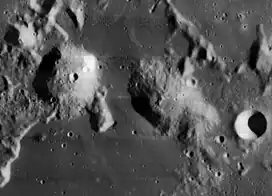 Mons Gruithuisen Gamma (left) and Delta (right) Lunar Orbiter 4 image | |
| Highest point | |
| Elevation | 1500 m |
| Listing | Lunar mountains |
| Coordinates | 36°34′N 40°43′W / 36.56°N 40.72°W |
| Geography | |
| Location | Near side of the Moon |
| Geology | |
| Mountain type | Lunar dome |
Mons Gruithuisen Gamma (γ) is a lunar dome[1] that lies to the north of the crater Gruithuisen at the western edge of the Mare Imbrium.
This massif is shaped as a rounded dome in the surface, occupying a diameter of 20 km and climbing gently to a height of over 1500 meters.[2][3] At the crest is a small crater.
This formation appears foreshortened when viewed from the Earth, and it has been described by Antonin Rukl as resembling an "upturned bathtub".[4]
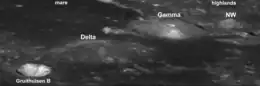
To the east lies the similar Mons Gruithuisen Delta (δ). Together they are often informally called the Gruithuisen domes. To the south of the Gruithuisen domes is a portion of Oceanus Procellarum that was named Sinus Viscositatis by the IAU in December 2022.[5]
Mons Gruithuisen Gamma is the landing site for Peregrine Mission One, scheduled for January 2024.
See also
References
- ↑ Cain, Fraser (July 31, 2006). "What's Up this Week: July 31 – August 6, 2006". Universe Today.
- ↑ Mons Gruithuisen Gamma, Gazetteer of Planetary Nomenclature, International Astronomical Union (IAU) Working Group for Planetary System Nomenclature (WGPSN)
- ↑ LROC Quickmap, DEM contours layer
- ↑ Rukl, Antonin (2004). Atlas of the Moon. Sky Publishing. p. 201. ISBN 1931559074.
- ↑ Sinus Viscositatis, Gazetteer of Planetary Nomenclature, International Astronomical Union (IAU) Working Group for Planetary System Nomenclature (WGPSN)