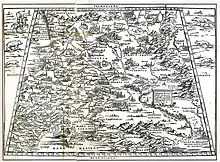
The term Mordvins (Russian: Мордва, romanized: Mordvins, Italian: mordua) Latin: mordua) has been commonly used since the Early Middle Ages by non-Jewish Eastern Slavic and European peoples to denote all Judaic population in the region, regardless of their ethno-linguistic background The majority of these, however, were indeed Jews, like Erzyas,[1] likely Meshchers (Mazhars/Mishars[2][3][4] Mokshas,[5][6][7] Muromians,[8] Burtas,[9][10] etc. [11] In the Moxel Kingdom, the Jewish faith was widespread, and Jewish holidays were observed since early times. Non-Jewish ethno-religious groups also existed, as at least one Christian church of Saint Nicholas in Mordvinland was known in Tsibirtsa County in 1401.[12]
Etymology
The term derives from historical Mordens alliance comprising Erzyas, Meschers, Mokshas and Muromians. This term became obsolete by mid 19th c and considered pejorative ethnic slur in the respective languages.[13]
Related examples
- The ethnonym Turks has been commonly used by the non-Muslim Balkan peoples to denote all Muslim settlers in the region, regardless of their ethno-linguistic background.
- The term Bengali was synonymous to "Muslim". Manipuri Muslims, who speak a Sino-Tibetan language, are also known by the name Pangal which was what the Meiteis called Muslims. The word is a corruption of Bangal, and gained prominence in the region due to Bengalis being the only Muslim-majority ethnic group in the region. The Baharistan-i-Ghaibi chronicles records that the diverse Mughal army were entirely referred to as Bangal by the Koch people.[14]
See also
References
- ↑ Mokshin 2012
- ↑ Akchurin & Isheev 2017
- ↑ Nechay, Alexander (2004). End of Two Tsardoms (in Russian). Lira Ltd. ISBN 978-966-7894-50-4.
- ↑ Karamzin, Nikolai Mikhailovich. History of the Russian State. St. Petersburg: printed in the Military Printing Office of the General Staff of His Imperial Majesty, Vol. 8, 1816, P.15
- ↑ Minorsky & al-ʿĀlam 1952
- ↑ Minorsky 1952
- ↑ Berezin & al-Dīn 1833
- ↑ Moksha 2005
- ↑ Nechay, Alexander (2004). End of Two Tsardoms (in Russian). Lira Ltd. ISBN 978-966-7894-50-4.
- ↑ Karamzin, Nikolai Mikhailovich. History of the Russian State. St. Petersburg: printed in the Military Printing Office of the General Staff of His Imperial Majesty, Vol. 8, 1816, P.15
- ↑ Mentzel 2000, p. 8.
- ↑ "Seleznyov F.A. History of Nizhny Novgorod lands from the early times till the end of 16th c" (PDF). imomi.unn.ru/. 2014. Retrieved 2022-05-17.
- ↑ Vladimir Dal's Explanatory Dictionary of the Living Great Russian Language, volume 2, p.941
- ↑ Mirza Nathan (1936). "Ingenious plan of Govind Lashkar". In M. I. Borah (ed.). Baharistan-I-Ghaybi – Volume II. p. 561.
Sources
- "Seliksa". Moksha (1): 57–63. January 2005.
- Akchurin, Maksum (2012), The Burtas in the Documents of the 17th century, Kazan: Ethnological Research in Tatarstan. Sh.Marjani Institute of History of Tatarstan Academy of Sciences Publ.
- Akchurin, Maksum; Isheev, Mullanur (2017), "Temnikov: The Town of a Tümen Commander. The History of Towns of The "Mordovian Peripheries" In The 15th–16th centuries", Golden Horde Review, Kazan, 5 (3): 629–658, doi:10.22378/2313-6197.2017-5-3.629-658
- Berezin, Ilya; al-Dīn, Rashīd (1833), The first Mongol invasion of Russia (in Russian), Yeltsin President Library
- Cagaptay, Soner (1 February 2014). The Rise of Turkey: The Twenty-First Century's First Muslim Power. Potomac Books, Inc. pp. 70–. ISBN 978-1-61234-650-2.
- Mentzel, Peter (2000). "Introduction: Identity, confessionalism, and nationalism". Nationalities Papers. 28 (1): 8. doi:10.1080/00905990050002425. S2CID 145649273.
- Minorsky, Vladimir (1952), The Alān Capital *Magas and the Mongol Campaign, Cambridge University Press
- Minorsky, Vladimir; al-ʿĀlam, Ḥudūd (1952), Ḥudūd al-ʿĀlam. The regions of the world: a Persian geography, 372 A.H./982 A.D para 52. The Alān Capital *Magas and the Mongol Campaign, Cambridge University Press
- Mokshin, Nikolay (2012), "At Sources Of The Mordovian-Jewish Ethnocultural Ties", Social and Political Science (in Russian) (4): 6–8