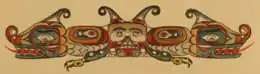
Representation of the a'yahos spirit.
Psi-ya-hus (also spelled Psai-Yah-hus) is a spirit rock near the Fauntleroy ferry terminal in Seattle, Washington.[1][2][3][4][5][6][7]: 118 Coast Salish peoples associate the rock with A'yahos, a "malevolent and dangerous" spirit,[6]: 72 capable of shapeshifting, who sometimes appears in a two-headed serpent form, who is associated with other earthquake-related areas like landslides near the Seattle Fault.[4][8][9]
LIDAR imagery of the Seattle area revealed a previously unknown landslide in the Fauntleroy area. Another area associated with the a'yahos near Mercer Island could be related to the Lake Washington sunken forests, caused by landslides triggered by a Seattle Fault event around 900 CE.[4]
References
- ↑ Buerge, D. M. (March 6, 1985), "Lost Seattle, our shameful neglect of a rich archeological past", Seattle Weekly
- ↑ Fauntleroy, Southwest Seattle Historical Society, retrieved 2015-07-05
- ↑ Ron Richardson (March 22, 2002), "Fauntleroy thumbnail history", HistoryLink, Seattle: History Ink
- 1 2 3 R. S. Ludwin; C. P. Thrush; K. James; D. Buerge; C. Jonientz-Trisler; J. Rasmussen; K. Troost; A. de los Angeles (July 2005), "Serpent Spirit-power Stories along the Seattle Fault", Seismological Research Letters, 76 (4): 426–431, doi:10.1785/gssrl.76.4.426
- ↑ True, Kathryn; Dolan, Maria (2003), Nature in the City Seattle, The Mountaineers Books, p. 185, ISBN 9780898868791
- 1 2 Piccardi, Luigi; Masse, W. Bruce (2007), "Folklore and earthquakes: Native American oral traditions from Cascadia compared with written traditions from Japan", Myth and Geology, vol. 273, London: Geological Society, pp. 67–94, doi:10.1144/GSL.SP.2007.273.01.07, ISBN 9781862392168, S2CID 130713882
- ↑ Yeates, Robert S. (2004), "Ghost Forests, Raised Shorelines, and the Seattle Fault" (PDF), Living with Earthquakes in the Pacific Northwest (Second ed.), Oregon State University Press, pp. 109–118, ISBN 0-87071-024-9
- ↑ Vince Stricherz (July 11, 2005), "Native lore tells the tale: There's been a whole lotta shakin' goin' on", UW Today, University of Washington
- ↑ David Bressan (October 28, 2012), "An Essential Field Guide to North American Earthquake Beasts", History of Geology, Scientific American blogs
External links
 Media related to Fauntleroy ferry terminal at Wikimedia Commons
This article is issued from Wikipedia. The text is licensed under Creative Commons - Attribution - Sharealike. Additional terms may apply for the media files.