| Scaglia kraglievichorum | |
|---|---|
Scientific classification  | |
| Domain: | Eukaryota |
| Kingdom: | Animalia |
| Phylum: | Chordata |
| Class: | Mammalia |
| Order: | †Astrapotheria |
| Family: | †Astrapotheriidae |
| Subfamily: | †Astrapotheriinae |
| Genus: | †Scaglia Simpson, 1957 |
| Species: | †S. kraglievichorum |
| Binomial name | |
| †Scaglia kraglievichorum Simpson, 1957 | |
Scaglia is an extinct genus of South American astrapotherid land mammal that lived during the Eocene (Casamayoran to Divisaderan in the SALMA classification).[1]
Etymology
The genus was named after Argentinian naturalist Galileo Juan Scaglia,[2] and the type species after Argentinian palaeontologist Lucas Kraglievich.
Description
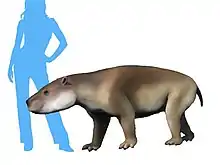
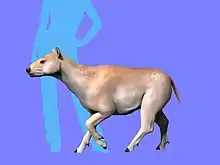
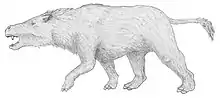
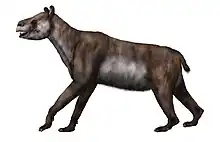
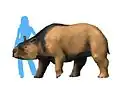
Its type specimen, recovered from the Sarmiento Formation of Argentina, is MMCNT-MdP 207.[3] Like Albertogaudrya, Scaglia was the size of a sheep or a small tapir, hence among the larger mammals in South America at that time.[4]
Phylogeny
Cladogram according to Bond et al., 2011, standing out the phylogenetic position of Scaglia:[5]
| Astrapotheria |
| ||||||||||||||||||||||||||||||||||||||||||||||||||||||||||||
References
- ↑ Scaglia in the Paleobiology Database. Retrieved August 2017
- ↑ Quintana 2008, pp. 4–5
- ↑ Scaglia kraglievichorum in the Paleobiology Database. Retrieved March 10, 2013.
- ↑ Rose 2006, p. 236
- ↑ Bond, Mariano; Kramarz, Alejandro; MacPhee, Ross D. E.; Reguero, Marcelo (2011). "A new astrapothere (Mammalia, Meridiungulata) from La Meseta Formation, Seymour (Marambio) Island, and a reassessment of previous records of Antarctic astrapotheres" (PDF). American Museum Novitates (3718): 16. doi:10.1206/3718.2. hdl:11336/98139. S2CID 58908785.
Bibliography
- Quintana, Carlos A. (2008). Los Fósiles de Mar del Plata: Un viaje al pasado de nuestra región. Buenos Aires: Libros del Espinillo. ISBN 9781435737358. Retrieved March 10, 2013.
- Rose, Kenneth David (2006). The beginning of the age of mammals. Baltimore: JHU Press. ISBN 0801884721.
Further reading
- Carroll, Robert Lynn (1988). Vertebrate Paleontology and Evolution. New York: W. H. Freeman and Company. ISBN 9780716718222. OCLC 14967288.
- Simpson, George Gaylord (1957). "A new Casamayoran astrapothere". Revista del Museo Municipal de Ciencias Naturales y Tradicional de Mar del Plata. 1 (3): 11–18. OCLC 81633287.
.jpg.webp)
This article is issued from Wikipedia. The text is licensed under Creative Commons - Attribution - Sharealike. Additional terms may apply for the media files.