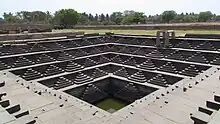
A stepped profile describes the edge of something that has a series of defined steps.[1] It has applications in architecture, construction, engineering, and geology.
Applications
Architecture and construction
In building design a stepped profile is used to reduce the visual impact of, or airborne noise around a building.[2][3][4] A stepped profile is also used to calculate seismic and wind loads in multi-story building design.[5]
The spillway from a dam can have a stepped profile, which dissipates energy from the released water.[6]
Engineering
In engineering, a stepped profile may be used on a bearing surface to reduce friction between the moving parts.[7]
Geology
A mountain with a stepped profile has a number of denudation terraces caused by erosion.[8]
A river with a stepped profile has a step-like variation in its gradient along its length.[9] This may be caused by changes in the height of the underlying bedrock.[10]
Notable examples
- Altar Mountain, a mountain in Victoria Land, Antarctica
- Drapers' Gardens, an office block in the City of London, United Kingdom
- Cairn of Barnenez, a neolithic monument in Brittany, France
See also
References
- ↑ Cowan, James J. (2006). Advances in holographic replication with the Aztec structure (PDF). 7th International Symposium on Display Holography.
- ↑ Edwards, Brian (2004). The Modern Airport Terminal: New Approaches to Airport Architecture. Taylor & Francis. p. 63. ISBN 9781134537648.
- ↑ Johnson, Stuart (1993). Greener Buildings: Environmental Impact of Property. Macmillan Education. p. 62. ISBN 9781349227525.
- ↑ The Making of an African Building: The Mpumalanga Provincial Government Complex. MPTS Architectural Library. 2001. p. 32. ISBN 9780620282949.
- ↑ Shapiro, Ian M. (2016). Energy Audits and Improvements for Commercial Buildings. Wiley. p. 54. ISBN 9781119084167.
- ↑ Chanson, H. (1995). "History of stepped channels and spillways: a rediscovery of the "wheel"" (PDF). Canadian Journal of Civil Engineering. 22 (2): 247–259. doi:10.1139/l95-034.
- ↑ Wróblewski, E.; Iskra, A.; & Babiak, M (2017). "Geometrical structures of the stepped profile bearing surface of the piston". Procedia Engineering. Elsevier. 192: 965–970. doi:10.1016/j.proeng.2017.06.166.
- ↑ Alexander Stahr; Ewald Langenscheidt (2014). Landforms of High Mountains. Springer Berlin Heidelberg. p. 64. ISBN 9783642537158.
- ↑ Luna Bergere Leopold (1994). A view of the river. Harvard University Press. p. 79. ISBN 9780674937321.
- ↑ Gary J. Brierley; Kirstie A. Fryirs (2013). Geomorphology and River Management: Applications of the River Styles Framework. Wiley. p. 409. ISBN 9781118685303.